Why the Plantation Is America's Most Unfilmable Haunted House
A Horror Film Analysis
For every Victorian mansion, crumbling asylum, and fog-drenched English estate in horror cinema, there is one setting that remains conspicuously absent: the American plantation.
Think about it. We have The Haunting, The Others, The Woman in Black, The Innocents—dozens of iconic films where British estates serve as characters in their own right. They creak. They moan. They hide guilty secrets behind velvet curtains. But the plantation? The white-columned manor draped in Spanish moss, surrounded by sun-drenched lawns? It appears in wedding photos, tourism brochures, and period dramas. Rarely—if ever—does it anchor a mainstream horror movie.
Why?
Because the plantation isn't just a house. It's America's original sin made architecture. And unlike the British, who turned their class guilt into gothic fiction, Americans have spent over a century trying to renovate, gentrify, and erase the very real ghosts that live there. This is the story of why the plantation remains America's unfilmable haunted house—and what happens when a filmmaker dares to open the door. To understand why plantations don't work as horror settings, we have to understand what makes a haunted house work in the first place.
The British Victorian mansion is fundamentally about inherited guilt. The ghost in the attic represents repressed trauma: the murdered wife, the abused servant, the unwanted child. These stories are conservative at their core. They say: Property is memory. Memory is trauma. And trauma will eventually surface. Audiences can process that. We can feel sympathy for the ghost. We can root for the living to escape. The horror is tragic, but it's containable. Now look at the plantation.
The plantation's history isn't about a single bad actor or a family secret. It's about systematic violence. Hundreds— thousands—of enslaved people were worked to death, sold, separated from families, raped, and buried in unmarked graves. That's not a haunting. That's a genocide with good architecture. You cannot make a traditional ghost story out of that because the ghost wouldn't be a sympathetic figure. The ghost would be a victim demanding justice. And the audience would quickly realize that the monster isn't the spirit—it's the family who built the house and the society that preserves it as a tourist destination.
Let's get specific. Why have there been almost no major plantation-set horror films when the setting is so obviously rich with tension?
1. The Aesthetic Problem
Plantations are beautiful. Cinematographers love the light filtering through oak trees, the symmetry of the columns, the romantic decay of Spanish moss. But horror needs ugliness. It needs rot, decay, and visible corruption.
You can make a Victorian manor look haunted by peeling wallpaper and flickering candles. To make a plantation look haunted, you'd have to show the slave quarters. The whipping post. The iron rings in the basement. Once you show those things, you're no longer making a haunted house movie. You're making a historical trauma film—and audiences don't buy popcorn for that.
2. The Spectator Problem
Who is the protagonist in a plantation horror movie? A modern white family who bought the plantation as a B&B? Congratulations: you're the villain. The audience will root for the ghosts. A Black family visiting for a wedding or reunion? Congratulations: you're asking viewers to relive generational trauma for entertainment. That's not catharsis. That's another news cycle.
A historian or journalist investigating the property? That works in theory, but the story inevitably becomes a lecture about American history rather than a horror narrative. There's no clean entry point. No one escapes unscathed. And that's precisely why studios pass.
3. The Genre Problem
Haunted house movies follow a reliable structure: someone moves in, strange things happen, the protagonist investigates, and the ghost is either defeated or laid to rest. There's resolution. Relief. But the plantation's ghost cannot be laid to rest.
Why? Because the plantation never ended. It just changed names: private property, prison labor, sharecropping, mass incarceration. You can't exorcise a system. You can't burn down a systemic institution. The horror isn't a single spirit—it's the continuity of injustice. That's not a three-act structure. That's a thesis statement.
If there's one film that comes closest to plantation horror, it's The Skeleton Key.
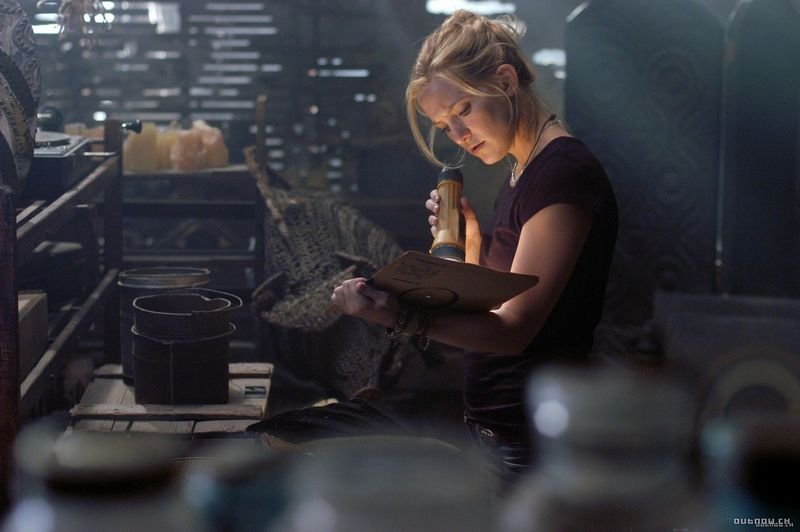
Kate Hudson in The Skeleton Key
The film is set in a decaying plantation house in Louisiana. But the horror isn't a ghost. It's Hoodoo—a living spiritual practice born from enslaved Africans. The house itself doesn't contain spirits; it contains a practice that allows people to swap bodies, trapping victims in the bodies of enslaved individuals.
The twist is devastating: the villains are immortal white landowners who steal Black bodies to survive. It's a metaphor so literal that critics didn't know how to categorize it. They called it "Southern Gothic" rather than horror because "horror" would mean admitting the plantation is a torture chamber, not a tourist attraction. The Skeleton Key works because it doesn't try to exorcise the plantation. Instead, it reveals the plantation as a living machine that consumes and replaces. The house doesn't need ghosts. It needs fresh bodies.
Jordan Peele never set Get Out on a plantation. But he didn't need to.
Look at the Armitage estate: white columns, sprawling lawns, a sunken basement where Black bodies are stored. Chris is invited to dinner not as a guest, but as livestock. The horror comes from the smile, the mint julep, the "we're family" lie—then the hypnotism, then the surgery.Peele understood that the plantation is a template, not a location. You don't have to film on an antebellum estate to capture its essence. You just have to replicate the power dynamics: wealthy white family, polite racism, a beautiful house that hides a dungeon, and a Black protagonist who's trapped by hospitality.
In Get Out, the horror isn't the house. It's the system that the house represents. And that's far more terrifying than a creaking door.
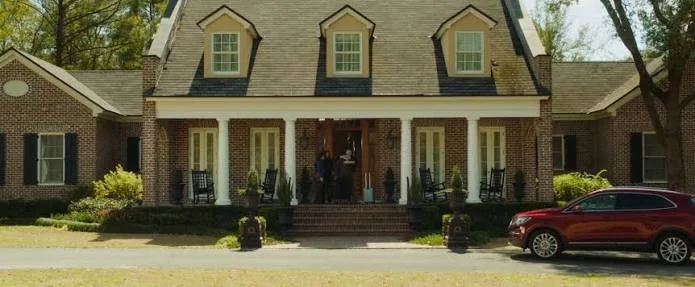
The Armitage Home evokes the Antebellum style
So what would an honest plantation horror movie actually look like? It would break every rule of the genre. No jump scares. The horror should be slow, creeping, and inevitable. No tragic ghost. The victims wouldn't be spirits demanding revenge. They'd be absent—erased from the record entirely. No final girl escaping through the woods. Because the plantation isn't a building. It's the entire landscape. No exorcism. The film would end with the protagonist realizing that there is no ritual, no prayer, no flame that can cleanse the land. Only acknowledgment. Only confession.
No resolution. No catharsis. Just a question: What are you going to do now that you know?
Is that a movie anyone would pay to see? I don’t know but it's the only honest one.
In 2025, plantation weddings are still happening. Confederate statues are still standing. The American education system still sanitizes antebellum history. The plantation isn't a haunted house because ghosts are real. It's a haunted house because we refuse to acknowledge what happened there. And in horror, the most terrifying monsters are always the ones we refuse to see. So the next time you watch a haunted house movie, ask yourself: Where's the American version? And if you can't find it, remember—that silence is the scariest thing of all.
Watch my YouTube video about this same topic and let me know what you think in the comments!